get a head.
get a head.
Brands & Websites
ReframeXR: Brand, Website & Content Strategy
ReframeXR: Brand, Website & Content Strategy
ReframeXR: Brand, Website & Content Strategy
A mixed-reality edtech startup selling into a category schools had never heard of. Rebuilt the brand, site and content strategy around school problems instead of the technology — demos now book through the site, and a large district signed on.
A mixed-reality edtech startup selling into a category schools had never heard of. Rebuilt the brand, site and content strategy around school problems instead of the technology — demos now book through the site, and a large district signed on.
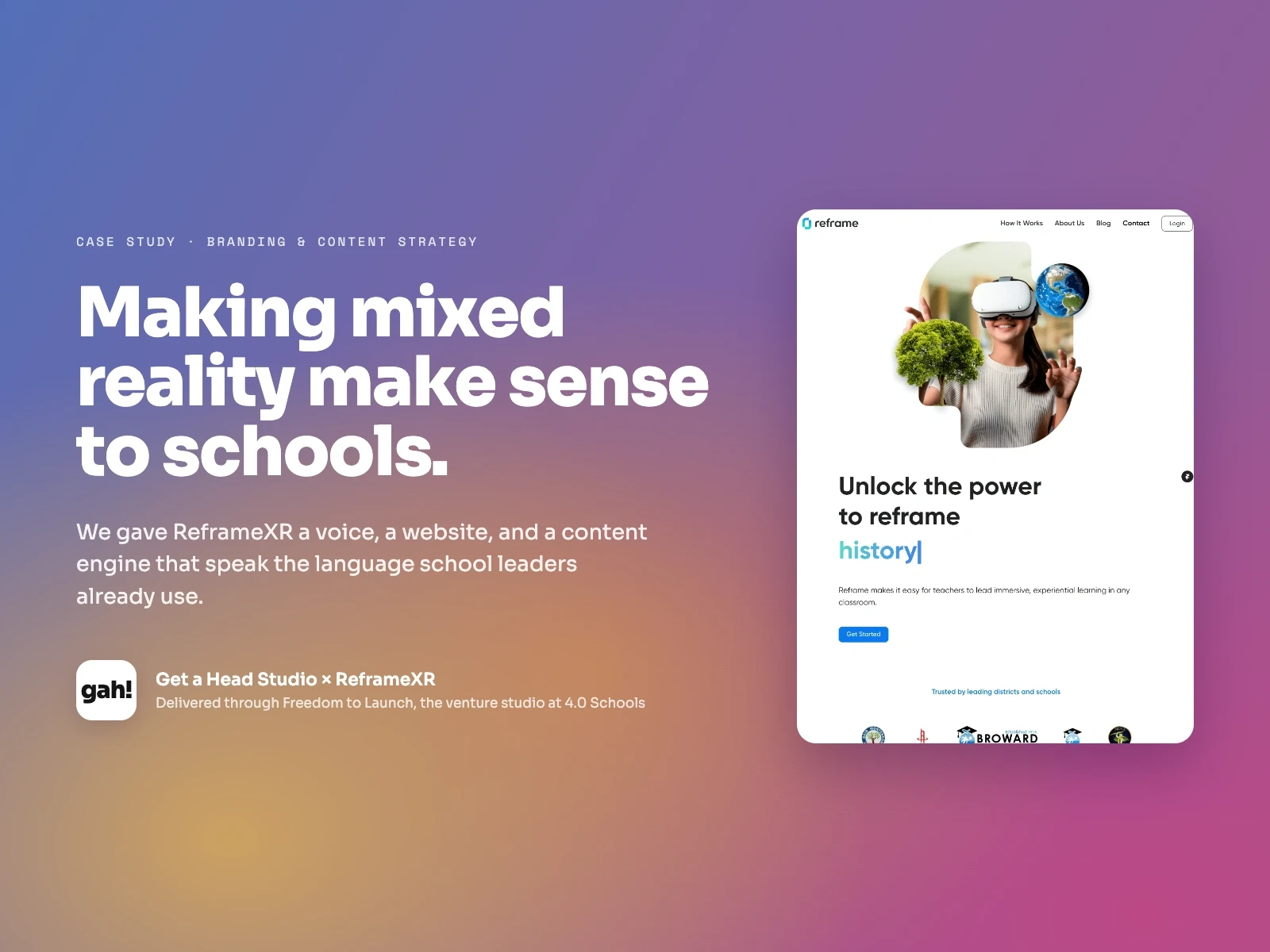
ReframeXR
Brand, website and content strategy
The challenge
ReframeXR had built a mixed-reality platform for classrooms and hit the problem that kills good edtech: schools didn’t know the category existed.
When a buyer has no mental slot for what you sell, every conversation starts from zero. You spend the meeting explaining the technology instead of the problem it solves, you sound like every other vendor who’s ever pitched a headset, and you rarely reach the person with budget authority.
The product wasn’t the issue. The explanation was.

What I built
Branding workshops to define ReframeXR’s voice and value proposition — run with the team rather than delivered to them, because the founders have to be able to say this out loud in meetings I’m not in.
A website rebuild that leads with what a school gets rather than what the hardware does, in the language school leaders already use with each other.
Market research on how schools actually search for and evaluate new tools, which turns out to look less like software procurement and more like curriculum adoption.
A content strategy on five pillars: collaborative learning, teacher support, accessibility, standards alignment, and engagement and outcomes. Each one maps to something a principal is already accountable for.
Blog and LinkedIn content aimed at educators and administrators — the people who decide whether a pilot happens, and who mostly aren’t being spoken to well by anyone in this category.


What changed
Sales conversations shifted from explaining mixed reality to solving specific school problems. That’s the change everything else depends on — it moved ReframeXR from “interesting technology” to “thing that addresses a problem I have on Tuesday.”
Concretely: the new site started generating booked demos directly, and the company brought a large new district on board after launch. The LinkedIn work opened direct lines to decision-makers, and the SEO-focused content made the company findable by people searching for their problem rather than for a category name they don’t know.

Delivered through Freedom to Launch, the venture studio I built and ran at 4.0 Schools. Built with Framer and Figma.
ReframeXR
Brand, website and content strategy
The challenge
ReframeXR had built a mixed-reality platform for classrooms and hit the problem that kills good edtech: schools didn’t know the category existed.
When a buyer has no mental slot for what you sell, every conversation starts from zero. You spend the meeting explaining the technology instead of the problem it solves, you sound like every other vendor who’s ever pitched a headset, and you rarely reach the person with budget authority.
The product wasn’t the issue. The explanation was.
What I built
Branding workshops to define ReframeXR’s voice and value proposition — run with the team rather than delivered to them, because the founders have to be able to say this out loud in meetings I’m not in.
A website rebuild that leads with what a school gets rather than what the hardware does, in the language school leaders already use with each other.
Market research on how schools actually search for and evaluate new tools, which turns out to look less like software procurement and more like curriculum adoption.
A content strategy on five pillars: collaborative learning, teacher support, accessibility, standards alignment, and engagement and outcomes. Each one maps to something a principal is already accountable for.
Blog and LinkedIn content aimed at educators and administrators — the people who decide whether a pilot happens, and who mostly aren’t being spoken to well by anyone in this category.
What changed
Sales conversations shifted from explaining mixed reality to solving specific school problems. That’s the change everything else depends on — it moved ReframeXR from “interesting technology” to “thing that addresses a problem I have on Tuesday.”
Concretely: the new site started generating booked demos directly, and the company brought a large new district on board after launch. The LinkedIn work opened direct lines to decision-makers, and the SEO-focused content made the company findable by people searching for their problem rather than for a category name they don’t know.
Delivered through Freedom to Launch, the venture studio I built and ran at 4.0 Schools. Built with Framer and Figma.
Want results like these?
Tell me what you’re working on. Free 30-minute call, no pressure, and you leave with a clearer plan either way.
get a head.
© 2026 Get a Head Studio. All rights reserved.